The inverter matters more than the panels. It converts DC from your roof into AC that your home can use. Choose wrong, and you lose performance every day for 25 years.
Three architectures exist: string, microinverter, and hybrid. This guide covers how they work, what they cost, and which suits your Perth roof. Perth Solar Warehouse installs string and hybrid inverter architectures from Fronius, Sungrow, Goodwe, Sigenergy, and Tesla. We don’t stock microinverters, which is why this guide can be honest about when they’re the right choice and when they’re not.
Quick insight
- The inverter matters more than the panels. Same panels on a different inverter will produce different results for 25 years. Choose this component carefully.
- Hybrid is the real 2026 question, not micro vs string. If a battery is on your roadmap within five years, a hybrid inverter avoids paying twice when you add storage later.
- Shading is the only reason to pay the microinverter premium. On unshaded Perth rooftops, a quality string inverter captures virtually the same energy at 25 to 40 percent lower cost.
- CSIP-AUS compliance from May 2026 is non-negotiable. All string and hybrid inverters in the Perth Solar Warehouse range comply. Microinverter systems depend on the gateway, so confirm before committing.
Contents
How solar inverters work
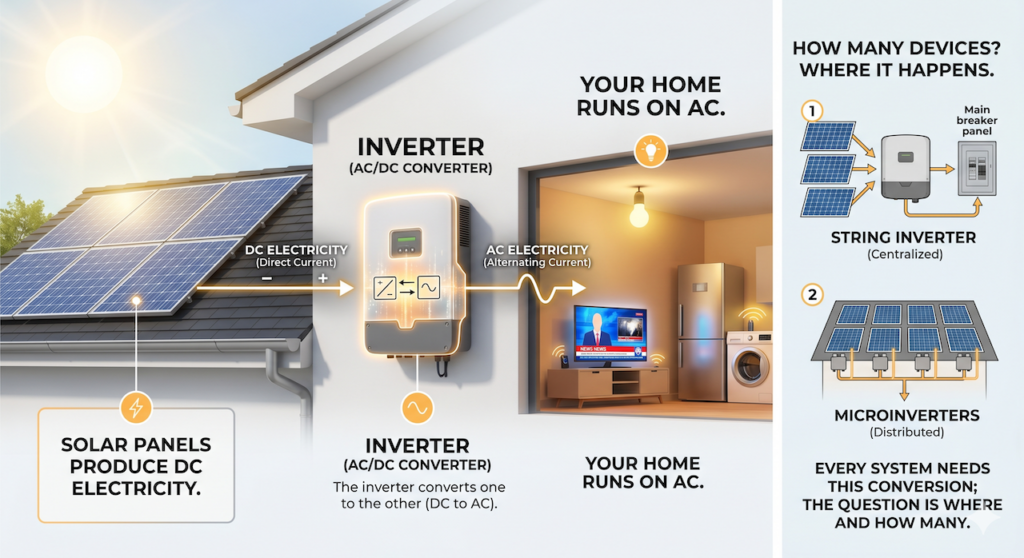
Solar panels produce DC electricity. Your home runs on AC. The inverter converts one to the other. Every system needs this conversion; the question is where it happens and how many devices do the work.
String inverters
When they make sense
One box on your garage wall. All panels wired in series feed into this single inverter for DC-to-AC conversion. It’s the most common type in Perth and across Australia: proven, cost-effective, and well-suited to the majority of WA rooftops.
Most Perth homes have pitched, north-aspect roofs with minimal shading. On these roofs, a string inverter captures virtually the same energy as a microinverter at significantly lower cost.
- Strengths: Lowest upfront cost ($1,000–$2,500 installed on a 6.6 kW system), simple one-device installation, easy wall-mounted servicing, decades of proven field reliability.
- Trade-offs: One shaded panel drags down the entire string. 10–12 year warranty means budgeting for a mid-life replacement. System-level monitoring only. Single point of failure.
- Best for: Unshaded roofs, one or two orientations, budget-first installs.
Microinverters
When they make sense
A small inverter mounts behind each panel, converting DC to AC independently. Panels are wired in parallel; each operates as its own power plant. Enphase (IQ8 series) dominates the market; Hoymiles and APsystems are emerging alternatives.
The honest take for Perth: On an unshaded roof, the majority of Perth metro homes, the performance gap between microinverters and a quality string inverter is marginal. The 25-year warranty is genuine, but the premium is hard to justify without real shading. Clear roof = string or hybrid. Shaded roof = microinverters earn it.
- Strengths: Panel-level independence, 25-year Enphase warranty (no mid-life replacement), panel-level monitoring, easy expansion, lower DC voltage on roof.
- Trade-offs: 30–50% higher upfront cost ($3,000–$6,000 more on a 6.6kW system), 15 roof-mounted components to maintain, roof access required for servicing, and battery integration requires a separate AC-coupled unit.
- Best for: Shaded roofs. Each panel works independently, so shade on one has zero impact on the others. On heavily shaded roofs, that’s ~10 to 25% more annual energy than a string inverter on the same roof.
Perth Solar Warehouse does not stock Enphase. Our range focuses on hybrid-capable inverters with battery integration, reflecting how most Perth systems are designed in 2026. If a shading analysis shows that microinverters are the best fit, we’ll let you know and recommend an installer who carries them.
Hybrid inverters
Perth's most popular option in 2026
A hybrid does everything a string inverter does, plus manages battery storage in one unit. No separate battery inverter needed. This is what Perth Solar Warehouse installs most in 2026: battery attachment rates are rising, Synergy’s DEBS makes time-shifting valuable, and a hybrid future-proofs your system.
Hybrid brands PSW installs: Fronius Gen24 (passive cooling, BYD and Fronius Reserva pairing) · Sungrow SH-RS/RT (SBR/SBH battery, excellent value) · Goodwe ESA (all-in-one cabinet, whole-home backup) · Sigenergy SigenStor (premium ecosystem, 25kW DC EV charger) · iStore (Huawei-manufactured, Malaga WA support) · Tesla Powerwall 3 (All-in-one solution, Tesla energy ecosystem)
Why hybrid is the real 2026 comparison: The traditional micro vs string debate misses the point for most Perth homes. If you’re considering battery storage within five years, a hybrid saves you from replacing your inverter or adding an expensive AC-coupled battery later. With DEBS paying variable export rates, storing daytime solar for evening peak use is where the real bill reduction happens.
Head-to-head
Feature | String Inverter | Microinverter | Hybrid Inverter |
|---|---|---|---|
Upfront cost (6.6kW system) | $1,000–$2,500 | $2,500–$4,500 | $2,000–$4,500 |
Warranty | 10–12 years | 25 years (Enphase) | 10–12 years |
Shading tolerance | Weakest panel limits string | Each panel independent | Weakest panel limits string |
Battery compatible | AC-coupled only (add later) | AC-coupled only | DC-coupled built in (nominated batteries) |
Monitoring | System-level only | Panel-level | System-level (some offer panel-level with add-ons) |
CSIP-AUS compliant | Depends on make/ model | Depends on gateway/envoy | Yes (all PSW-stocked brands) |
Noise | Low | Silent | Low |
Expansion | May need inverter resize | Add panels freely | May need inverter resize |
Mid-life replacement cost | $1,500–$3,000 at year 10–15 | None (25-year warranty) | $2,500–$5,000 at year 10–15 |
Best for | Unshaded, budget-first | Shaded, complex roofs | Battery-ready, future-proofed |
Perth’s conditions
Affect your inverter choice
Irradiance: STC Zone 3, among the highest in Australia. Great for generation, but with high year-round operating temperatures. Temperature coefficients matter, and they’re a panel spec, not an inverter spec.
Grid: SWIS network (Western Power + Synergy). Current 5kW single-phase export limit transitioning to 30kVA aggregate under CSIP-AUS from May 2026.
Typical roof: Pitched, single-orientation, minimal shading. This profile suits string or hybrid. Microinverters add value only where shading, multi-plane layouts, or complex hip roofs make string design difficult.
Coastal: Burns Beach to Rockingham — salt mist means IP rating matters. All-in-one units like the Goodwe ESA (IP66) suit outdoor coastal installation better than separate components.
What about Enphase?
Enphase is the global microinverter leader: 25-year warranty, excellent monitoring, lowest documented failure rates. Perth Solar Warehouse doesn’t stock Enphase because our range is focused on hybrid inverters with integrated battery management, which is how most Perth systems are designed in 2026.
If your roof has shading challenges a hybrid can’t address, we’ll tell you. Honesty is worth more than a sale.
Inverters PSW installs
Brand | Type | Positioning | Learn More |
|---|---|---|---|
Fronius | String + Hybrid (Gen24) | Austrian-made, passive cooling, premium build quality | |
Sungrow | String + Hybrid (SH-RS) | Global #1 by volume, strong value, SBR battery pairing | |
Goodwe | Hybrid + All-in-one (ESA) | ESA combines inverter + battery in one cabinet, lowest cost per kWh | |
Sigenergy | Hybrid + EV integration | Premium ecosystem, 25kW bidirectional DC EV charger, Gold Certified Installer | |
SMA | String + Hybrid | German engineering, long track record, strong commercial heritage | Contact us |
iStore | Hybrid (Huawei-manufactured) | Full home electrification ecosystem, Australian HQ in Malaga WA |
Common questions
Are microinverters worth the extra cost in Perth?
On most Perth roofs, unshaded, single-orientation, the performance gap is marginal. The 25-year warranty is real, but the 30–50% premium is hard to justify without actual shading. For shaded roofs in leafy suburbs, microinverters recover 10–25% more energy annually, paying back the premium within 3–5 years.
Can I add a battery to a microinverter system?
Yes, via an AC-coupled battery (Franklin WH). Works well but adds cost versus a DC-coupled battery on a hybrid inverter. See our compare solar batteries page.
What happens if my string inverter fails?
The whole system stops until replaced. Covered by 10–12 year manufacturer warranty. Budget $1,500–$3,000 for replacement at year 10–15. Perth Solar Warehouse backs every install with our own workmanship guarantee, one call to Bibra Lake or Neerabup.
Does Perth Solar Warehouse install microinverters?
Not currently. We focus on string and hybrid inverters. If shading analysis shows microinverters are the best fit, we’ll say so and recommend a suitable installer.
Which inverter type is best for a shaded roof in Perth?
Microinverters. Each panel produces independently, so shade on one doesn’t affect the rest. DC optimisers (SolarEdge) offer a middle ground, though PSW doesn’t currently carry SolarEdge.
Final takeaway
Unshaded roof + want battery-readiness → Hybrid inverter. Where most Perth homeowners land in 2026.
Unshaded roof + budget-first → String inverter. Cheapest, proven, reliable. Budget for one replacement at year 10–15.
Shaded roof on multiple planes → Microinverter. 10–25% generation gain is real. Get a shading analysis first, don’t guess.
Perth Solar Warehouse designs systems around your roof, not around a single brand. Request a quote, and we’ll recommend the right inverter type with transparent pricing and all applicable rebates included.