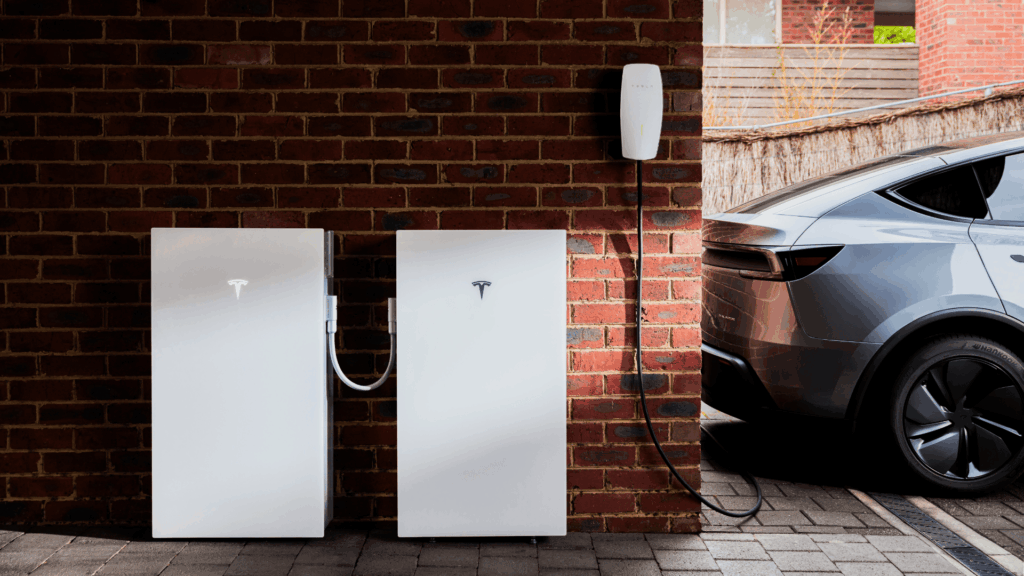
Powerwall 2 and Powerwall 3 are becoming cross-compatible

If you have an existing Powerwall 2 system, good news is on the way. Tesla has confirmed that a software update due in June 2026 will allow Powerwall 2 and Powerwall 3 units to work together seamlessly in the same home.

Until now, the two Powerwall generations have been separate product lines. That means homeowners with an existing Powerwall 2 who wanted to expand their battery storage had limited options. The upcoming firmware update changes that entirely. Your Powerwall 2 stays exactly as it is, and a Powerwall 3 can be added alongside it.

No hardware changes are needed to your existing system. Tesla has confirmed that current Powerwall 2 installations remain fully compliant, and the new compatibility is delivered through a software update only.

Coming June 2026: Tesla’s firmware update will enable combined Powerwall 2 and Powerwall 3 operation. Nothing changes with your existing system ahead of the update. We’ll keep you informed as the rollout approaches. 

This is a genuine upgrade pathway for existing Powerwall 2 customers who’ve been waiting to grow their system. If you’d like to understand what this means for your home specifically, our team is happy to walk you through the options.

Note: This post is based on communications received from Tesla Energy ahead of the firmware release. Details are subject to change as Tesla releases official documentation closer to the June 2026 launch. 

Further reading

Detailed customer overview, PSW Energy: Powerwall 2 got a big upgrade path

Employee facing summary, McKercher Corporation: Powerwall 2 & Powerwall 3 compatibility 

What the cheapest battery quote actually costs

A home battery is one of the most significant purchases a household will make. The quote is the beginning of that conversation, not the end of it.

Battery storage has moved quickly from a premium add-on to a mainstream consideration for Perth households. Rising electricity costs, improving technology, and the maturation of grid-connected systems have brought home batteries into the purchasing conversation for a far broader slice of the market than was the case even three years ago. With that growth has come a corresponding expansion of the installer field, and, inevitably, a widening of the price gap between them.

For a buyer comparing quotes, that gap can look like a straightforward opportunity. It is rarely that simple.

Contents

What a battery quote actually contains: A home battery installation involves more moving parts than most buyers anticipate. Beyond the battery unit itself, its chemistry, capacity, and warranty. Then there is the inverter configuration, the switchboard assessment, the grid-compliance documentation, the network operator approval process, and the commissioning of the monitoring platform that the household will rely on throughout the system’s operational life.

Each of those elements represents a cost. The question a comparison quote rarely answers is which of those costs have been absorbed, and which have been deferred to a future invoice, a future service call, or simply to the customer.

💡 The cheapest battery quote in Perth isn’t always the best. Sometimes it is simply a quote that has excluded things the buyer does not yet know to ask about, and will only discover once the system is installed, the installer has moved on, and something requires attention.

Western Australia’s energy transition is real, it is accelerating, and home battery storage is a meaningful part of it. Getting there with a credentialled, proven installer is not a premium; it is the baseline expectation every buyer deserves.

The support lifecycle most buyers don't consider

A home battery is a ten- to fifteen-year asset. Battery management firmware evolves. Inverter compatibility requirements shift. Grid regulations, particularly those on export controls and virtual power plant participation, are being actively revised across Western Australia as the network adapts to high solar penetration. A system installed today will need to be compliant, monitored, and serviceable throughout that entire period.

That ongoing relationship requires an installer who will still be operating in five years. In WA’s battery storage sector, that is not a certainty across the market. Businesses that entered on the back of subsidy-driven demand peaks have, in a number of documented cases, exited just as the market normalised, leaving customers with systems that function adequately on a good day, but have no commercial backstop when they don’t.

The cost of finding a replacement service provider for an orphaned battery system, one whose original installer no longer exists, is rarely trivial and falls entirely on the household. It does not appear in any comparison quote.

What longevity signals in this market

A battery installer that has operated continuously through multiple market cycles has demonstrated something substantive: the capacity to sustain a business through the ebbs and flows that characterise an emerging technology sector. It has retained trained staff. It has maintained manufacturer relationships. It has kept its accreditations current through the audits and compliance processes required by those accreditations.

These are not incidental details. They are the operational infrastructure that enables long-term support. And they cost money to maintain, which is one of the reasons businesses that carry them do not tend to offer the lowest quote in the market.

Perth Solar Warehouse operates in what might be described as the credentialled middle of the battery market, not the cheapest option, nor a premium-only commercial operator. The positioning is deliberate; deliver installations that are properly scoped, properly documented, and supported by the infrastructure throughout the system’s lifecycle. As a guide, value-driven businesses should deliver a similar broader industry alignment:

The credentials that matter specifically

Battery storage installations in Australia sit within a framework of accreditation and certification requirements that are more demanding than those for solar alone. The combination of high-voltage DC systems, grid interconnection, switchboard modification, and network operator compliance means that the credentials an installer holds are a meaningful indicator of their competence and accountability.

Accreditation

NETCC
Accredited

National baseline standard for quality and compliance: A prerequisite, not a differentiator.

Manufacturer

Tesla Premium
Certified Installer

Five consecutive years (PSW). Technical audits passed annually, not a one-time badge.

Manufacturer

Sigenergy
Gold Installer

Top-tier status with one of the fastest-growing integrated battery platforms on the planet.

Quality Systems

ISO
Certified

ISO 9001, 45001, 14001: Independently audited quality, safety, and environmental management.

The distinction worth understanding here is between credentials that are self-declared and those that require external audit and ongoing compliance. NETCC accreditation, manufacturer certification at the top installer tier, and ISO quality management certification all fall into the latter category. They can be lost. They require sustained investment to maintain. And their presence in an installer’s profile is evidence of a business that has chosen to be held to account, because it intends to be around long enough for that accountability to matter.

Questions worth asking before accepting a quote

The battery market in Western Australia is maturing, and with that maturity comes a more discerning buying public. Households are increasingly aware that a system’s long-term performance depends as much on the installer as on the hardware. The right questions to ask before committing are not technical; they are structural.

How long has the business been operating, and specifically in battery storage? Which manufacturer certifications does it hold, and when were those last audited? What does the support model look like after installation? Who do you call, and what response can you expect? Is the business financially structured to honour warranties over a ten-year horizon? And critically: what is explicitly included in the quote, and what is not?

💡 The installer worth choosing is not the one who quotes lowest. It is the one whose business is built to support what they install, across the full operational life of a system that will sit on your switchboard for the better part of a decade and a half.

Western Australia’s energy transition is real, it is accelerating, and home battery storage is a meaningful part of it. Getting there with a credentialled, proven installer is not a premium; it is the baseline expectation every buyer deserves.

If you’re considering a home battery, we’d welcome the conversation. No pressure, just honest advice from a team that’s been doing this for over two decades

All-Black Precision: Jinko Tiger Neo Dual-Glass 475W

Black solar panel with colorful background

The JKM450-475N-48HL4M-DB delivers up to 475W with N-type TOPCon precision in a fully black, dual-glass build — no compromises on aesthetics or performance.

The Jinko Tiger Neo All-Black with Dual Glass isn’t a subtle refinement; it’s a deliberate evolution in what an all-black solar panel should deliver. Where previous generation all-black panels asked homeowners to trade some performance for aesthetics, the ideal residential format 48HL4M-DB removes that compromise entirely. Built on the world’s most deployed N-type TOPCon foundation, wrapped in dual-glass durability, and rated to 475W peak in an all-black monofacial form, this is the panel for Perth homeowners who want the clean look done properly.

Quick insight

Jinko's N-type TOPCon difference

Negative-type charged (N-type) Tunnel Oxide Passivated Contact (TOPCon) cell architecture is the foundation of the Tiger Neo 48HL4M-DB. Jinko has shipped over 140 GW of Neo models globally across 2023–24, a deployment scale that validates both the technology and the manufacturer’s ability to deliver consistent quality at volume.

N-type TOPCon cells outperform conventional P-type (positively charged) cells in the ways that matter most in Perth’s climate: better efficiency under full sun, stronger performance as temperatures climb, and improved output in low-light and diffused conditions. With a temperature coefficient of just -0.29%/°C, the Tiger Neo All-Black loses less power on Perth’s hottest days than many competing panels rated at lower temperatures.

The 96-cell (48×2) layout, combined with JinkoSolar’s SMBB (Super Multi-Busbar) technology, improves both light trapping and current collection, contributing to the module’s headline efficiency of 23.77% at 475W.

💡 Insight: N-type TOPCon is now considered the baseline quality benchmark for solar panel cell architecture in 2025 and beyond. Not all TOPCon implementations are equal. Jinko’s manufacturing scale and consistency place it among the most validated options available.

Dual-Glass endurance

The 48HL4M-DB uses a 2.0 mm heat-strengthened glass rear panel in place of a conventional plastic back sheet. This dual-glass construction creates a more stable, sealed environment for the solar cell throughout its 30-year service life.

In Perth’s climate, hot summers, UV intensity, and salt-laden coastal air across much of the metro area, this matters. Dual-glass construction provides enhanced resistance to:

The result is a panel that maintains its rated output more reliably over a longer service life. Jinko’s 30-year linear performance warranty backs this, guaranteeing 87.4% of the original rated output at year 30, with a first-year degradation cap of just 1% and an ongoing annual rate of 0.40%.

💡 Insight: Dual-glass construction requires more precise engineering and component qualification than glass-laminate designs. Not every manufacturer produces dual-glass panels to the same standard. Jinko’s IEC61215:2021 and IEC61730:2023 certifications confirm that the 48HL4M-DB meets the latest international benchmarks.

HOT 3.0 and SMBB technology

Two proprietary Jinko technologies work in combination to lift the 48HL4M-DB above standard N-type TOPCon implementations:

HOT 3.0 (High Efficiency, Outstanding reliability, Top yield) improves module efficiency and long-term reliability. In practical terms, this means better light conversion across the operating day and reduced degradation risk over the panel’s lifespan.

SMBB (Super Multi-Busbar) technology optimises current collection across the cell surface, improving power output and reliability simultaneously. More busbars mean shorter current pathways, reducing resistive losses and improving tolerance to minor cell micro-cracks that can develop in any panel over years of thermal cycling.

Together, these technologies contribute to a panel that performs closer to its rated spec across real-world conditions, not just at standard test conditions (STC).

💡 Insight: STC (Standard Test Conditions) ratings are measured at a cell temperature of 25 °C and an irradiance of 1,000 W/m². Real-world output on a Perth rooftop will vary. But a panel with a lower temperature coefficient, better low-light performance, and tighter degradation characteristics will consistently outperform a nominally higher-rated panel that loses more in heat and over time.

Jinko Neo Satin all-black solar panels installed by Perth Solar Warehouse on a suburban rooftop in Darch, Western Australia with parland in the background.
Jinko Neo Satin all-black solar panels installed by Perth Solar Warehouse on a suburban rooftop in Scarborough, Western Australia on a white roof top.

Aesthetics to complement your style

The Jink Tiger Neo All-Black is a monofacial panel, and that’s a deliberate choice for rooftop aesthetics. With a fully black cell, black frame, and black dual-glass rear, there are no visual interruptions: no between cell lines, no white back sheet visible at the panel edges, no colour variation across the array.

Mounted as a complete system, a Tiger Neo All-Black array reads as a single flush surface. particularly effective on dark roof tiles or metal roofing, where the panels integrate rather than contrast.

💡 Insight: STC (Standard Test Conditions) ratings are measured at a cell temperature of 25 °C and an irradiance of 1,000 W/m². Real-world output on a Perth rooftop will vary. But a panel with a lower temperature coefficient, better low-light performance, and tighter degradation characteristics will consistently outperform a nominally higher-rated panel that loses more in heat and over time.

However, the panel alone doesn’t achieve the aesthetic result. It requires complementary hardware: black mounting rails, black fasteners, and black cable management, installed to manufacturer specifications. Perth Solar Warehouse specifies and installs all-black systems end to end, ensuring the finished result matches the design intent. Note: mounting brackets are reduce visibility underneath the solar array and are silver in appearance (stainless steel, aluminium: if looking between the array and the roofing material) 

Jinko Tiger Neo All Black specifications

Tiger Neo All Black datasheet

Electrical Characteristics (STC):

  • Maximum Power (Pmax): 475W  
  • Open Circuit Voltage (Voc): 36.91 V  
  • Short Circuit Current (Isc): 15.13 A  
  • Maximum Power Voltage (Vmp): 31.40 V  
  • Maximum Power Current (Imp): 15.13 A  
  • Module Efficiency: 23.77%  
  • Power Tolerance: 0 ~ +3W

Mechanical Specifications:

  • Dimensions: 1762 mm x 1134 mm x 30 mm
  • Weight: 24 kg
  • Cell Type: N-type monocrystalline
  • Number of Cells: 96 (48×2)
  • Frame: Anodised aluminium 
  • Front Cover: 2.0 mm glass
  • Back Cover: 2.0 mm glass
  • Connector: MC4-Evo2 (Staubli)
  • Cable: 4.0 mm² , (+) 400 mm, (-) 200 mm

Temperature Ratings & Coefficients:

  • Operating Temperature: -40°C to +70°C
  • Temperature Coefficient of Pmax: -0.29%/°C
  • Temperature Coefficient of Voc: -0.25%/°C
  • Temperature Coefficient of Isc: 0.045%/°C

Warranties & Certification:

  • Product Warranty: 25 years
  • Performance Warranty: 30-year linear

Warranty download

Certification download

The essential aspect

The manufacturer’s warranty for any Jinko Tiger Neo panel is conditional on installation by a Jinko-approved company in accordance with the manufacturer’s specifications. Without this, the product warranty does not apply.

Perth Solar Warehouse is a Jinko-certified installer. Our installation teams are trained to Jinko’s specifications, meaning the 25-year product warranty and 30-year performance warranty are fully intact from day one.

Beyond certification, the installer is a system component. The quality of the physical installation: cable management, mounting torque, waterproofing, and array layout, directly affects both immediate performance and long-term system integrity. Choose an installation company with a verifiable operational history, not just a current certification.

💡 Insight: A premium solar panel installed poorly will underperform a mid-range panel installed correctly. The installer is the critical link between the manufacturer’s specifications and your roof.

Availability

The Jinko Tiger Neo All-Black Dual-Glass (JKM450-475N-48HL4M-DB) is available now across the greater Perth and Bunbury regions through Perth Solar Warehouse in standard installed system sizes of 3, 6.6, 10, 13, 19 kW. For commercial and industrial applications of 30 kW and above, our commercial Jinko panel options may be more appropriate, contact PSW for a tailored assessment.

Tesla Powerwall 3 reviewed: what’s changed and why it matters

Tesla Powerwall 3, expansion pack and wall connector in a garage

Originally published 16 August 2024. Updated March 2026 with current pricing, rebates, expansion pack availability, cross-compatibility news, three-phase outlook, and vehicle-to-home developments.

When we first reviewed Tesla Powerwall 3 in mid-2024, it was a strong product with a clear direction. Eighteen months later, the direction has become a roadmap, and most of it is now either live or confirmed.

This is no longer a launch review. If you’re reading this in 2026, you’re most likely comparing home batteries, working out whether Powerwall 3 fits your property, or trying to understand what’s actually coming next versus what’s still speculation. This article covers all three.

Perth Solar Warehouse is Perth’s five-time consecutive Tesla Premium Certified installer. We’ve been fitting Powerwall systems since the original Powerwall 2 and have direct visibility on how these products perform in WA homes, how Tesla’s ecosystem is evolving, and where the real value sits for homeowners and small businesses in Western Australia.

Key points

For those short on time:

Which output model for your home

Tesla manufactures Powerwall 3 with 5kW, 10kW, and 11.5kW continuous AC output options. All three share the same 13.5kWh battery capacity and the same three-MPPT solar inverter capable of handling up to 20kW of DC solar input. The difference is the AC output cap, which is factory-set to comply with regional grid connection rules.

Which model applies to your home depends on your state, your supply type (single-phase or three-phase), and your network operator’s connection requirements. This is where the conversation has shifted significantly for WA homeowners.

If you read our original 2024 review, you’ll remember we stated that only the 5kW output model was relevant for single-phase homes in WA. That is no longer the case.

From 1 July 2025: Western Power increased the allowable single-phase inverter capacity on the SWIS from 5kVA to 10kVA. This means the 10kW output model of Tesla Powerwall 3 is now a valid option for single-phase homes in the Perth and Bunbury region. For most WA homeowners considering Powerwall 3 today, the 10kW model is the more practical choice, delivering double the continuous output for powering larger loads and faster self-consumption of stored energy.

From 1 May 2026: A further update takes effect, allowing up to 30kVA of aggregate inverter capacity under a standard connection (both single-phase and three-phase). This is a substantial increase and opens the door to larger combined solar and battery configurations. However, the expanded capacity comes with a new requirement: your system must either support Emergency Solar Management (ESM), which enables remote disconnect and reconnect controlled by your electricity retailer, or default to a fixed 1.5kW export limit.

In practical terms, ESM requires your inverter to be internet-connected and commissioned using the CSIP-AUS protocol. Most modern inverters, including Powerwall 3, already support this. Systems that maintain ESM capability can export energy to the grid as normal. Systems that cannot (or choose not to) will be capped at 1.5kW export.

All new and upgraded systems installed from 1 May 2026 must also comply with AS/NZS 4777.2:2020 and be configured to the Australia Region B grid profile.

Three-phase properties have different constraints. Under the current Western Power rules, each phase of a standard three-phase service is rated at 32A, and Western Power has maintained the 5kVA per-phase limit for single-phase inverters connected to a three-phase supply to manage phase imbalance and neutral voltage rise risks. A single-phase inverter larger than 5kVA on a three-phase supply must be generation-limited to 5kW.

Multiple single-phase inverters can be distributed across the three phases (up to 5kVA each, or larger units with phase balance protection per AS/NZS 4777.1). The total battery inverter capacity is limited to 10kW on single-phase and 15kW on three-phase, with an 8kW-per-phase cap for generation.

If you have a three-phase supply, the system design conversation is more nuanced. Your installer should assess your switchboard, existing generation, and phase loading before recommending a Powerwall 3 configuration.

Most DNSPs (Distributed Network Service Providers) across the eastern states allow higher inverter capacities on single-phase supplies. The 10kW and 11.5kW models are commonly installed in New South Wales, Victoria, Queensland, and South Australia. Some networks permit export limiting, which further expands configuration options. Check your local network operator’s connection requirements before quoting.

Grid connection rules differ by network operator and can change. The information above reflects rules current as of March 2026. Your installer is responsible for confirming compliance with the connection requirements at the time of installation.

What’s inside and why it matters

The defining change from Powerwall 2 to Powerwall 3 is the integrated solar inverter. Powerwall 2 was an AC-coupled battery. It stored energy but needed a separate solar inverter to generate it. Powerwall 3 combines both functions into a single unit.

For a new solar and battery installation, this simplifies the hardware stack significantly. One box on the wall replaces what used to be two. For existing solar system owners, it means Powerwall 3 can replace an ageing inverter and add battery storage in one step, though it does replace your existing inverter entirely rather than pairing alongside it.

Core specifications

Useable storage capacity
13.5kWh
Battery chemistry
Lithium iron phosphate (LFP)
Continuous AC output
5kW, 10kW, or 11.5kW (region-dependent)
DC solar input
Up to 20kW across 3 MPPTs (6 strings)
Round-trip efficiency
97.5%
Dimensions
1,050mm x 609mm x 193mm
Weight (installed)
132kg (including wall bracket and glass protector)
Operating temperature
–20°C to 50°C
Weather rating
IP67, flood-resistant to 0.6m
Warranty
10 years (internet connection required for full term)

The 97.5% round-trip efficiency is a standout figure. Most competing home batteries sit between 90% and 95%. In practical terms, less energy is lost in each charge and discharge cycle, which compounds over the 10-year warranty period into meaningful additional savings.

The 20kW DC solar input capacity is equally significant. On a single-phase 5kW connection-limited supply, you can still connect up to 20kW of solar panels directly into Powerwall 3. The panels generate more energy across a broader window of the day, charging the battery faster and extending the hours of useful production, particularly on overcast mornings and late afternoons.

Tesla's energy ecosystem in 2026

Tesla’s energy product strategy is built around a small number of devices that communicate through a shared software layer. This has always been the pitch, but in 2026 the ecosystem has matured to the point where it’s delivering on most of it.

Gateway

The Gateway is the system’s central controller. It monitors your home’s energy import and export at the point of supply, manages power distribution under normal operation, and orchestrates backup during a grid outage. A Gateway is required for every Powerwall 3 installation.

Tesla Wall Connector

Tesla’s EV charger supports both single-phase (7kW) and three-phase (11kW) power supplies. When connected to a Powerwall 3 system, it can prioritise charging your electric vehicle from excess solar energy rather than exporting to the grid. The Tesla App coordinates this automatically.

Tesla App

Tesla’s energy management app remains one of the more capable platforms in the residential battery space. Real-time and historical energy monitoring, Storm Watch (which pre-charges your battery before severe weather events), time-of-use optimisation, and device-level control are all managed through a single interface. The app also provides the pathway for firmware updates, which is how Tesla continues to add features postinstallation.

Firmware updates: the quiet advantage

This is worth pausing on. Tesla’s ability to push over-the-air firmware updates to Powerwall 3 means the product you buy today is not necessarily the product you’ll have in 12 months. Features get added, performance gets tuned, and compatibility gets expanded, all without a truck roll or hardware swap. The Powerwall 2 and 3 cross-compatibility update (covered below) is a direct example of this.

Firmware 26.2, which has already started rolling out, increases the battery charge rate to approximately 8kW for systems with DC expansion packs. Tesla has framed this as nearly 40% faster charging. That kind of improvement arriving as a free software update months after purchase is unusual in this market.

Tesla Powerwall 3, expansion pack and wall connector in a garage

Expansion packs: scaling storage to 54kWh

Tesla Powerwall 3 expansion packs are now available in Australia. Each expansion unit provides an additional 13.5kWh of storage capacity without a second inverter. The expansion pack connects directly to the Powerwall 3 leader unit and is managed through the same Tesla App.

A single Powerwall 3 supports up to three expansion packs, bringing the maximum system capacity to 54kWh from one inverter. For households with high overnight consumption, electric vehicles, or a desire for extended backup during outages, this changes the storage equation meaningfully.

What expansion packs cost

Because expansion packs omit the inverter, they cost $3,000 to $4,000 less than a full Powerwall 3 unit. Indicative pricing starts from $8,490 installed after rebates, depending on your location and site conditions. Each expansion pack is eligible for the federal Cheaper Home Batteries Program rebate.

Pricing is indicative and subject to change. Installation costs vary by site. Contact PSW for a current quote.

Powerwall 2 owners: your upgrade options

This has been one of the most requested developments since Powerwall 3 launched. Tesla has now confirmed that a firmware update will enable Powerwall 2 and Powerwall 3 to operate together in the same household system. Australia and New Zealand are confirmed as the first markets to receive this update.

The implication: if you already own a Powerwall 2, you no longer need to replace it to expand your storage with Tesla hardware. A new Powerwall 3 can be added alongside your existing unit, with both managed through the Tesla App and Gateway.

There are some details to watch. Powerwall 2 and Powerwall 3 operate on different architectures (AC-coupled versus DC-coupled with integrated inverter). How Tesla manages the combined system, particularly whether the Gateway needs updating, will matter. If you have an original Gateway 1, an upgrade to Gateway 2 may be required.

What to do now

  1. Check your Tesla App or installation paperwork to confirm you have a Powerwall 2
  2. Speak with your installer about switchboard capacity. Adding a Powerwall 3 increases system output significantly
  3. Register interest early. Demand is expected to spike once the firmware update drops

The Powerwall 2 was discontinued from sale in Australia in January 2026 and has been removed from the CEC-approved product list. It is no longer eligible for the federal battery rebate for new installations. This cross-compatibility update is Tesla’s way of ensuring existing owners have a forward upgrade path within the ecosystem.

Three-phase: what’s coming

In February 2026, Tesla announced the Powerwall 3P for Germany. This is a native threephase variant that integrates a three-phase inverter into a single unit. Instead of installing three separate Powerwalls (one per phase) to achieve whole-home backup on a three-phase supply, Powerwall 3P handles all three phases from one box.

For Australia, this matters. A significant number of newer homes, particularly in New South Wales, Victoria, and increasingly in WA, are wired with three-phase power. The current single-phase Powerwall 3 can be installed on a three-phase property, but during a blackout it only backs up the single phase it’s connected to. The other two phases go dark.

When will it arrive in Australia?

Tesla has not announced an Australian timeline for the Powerwall 3P. Before it can be sold and installed here, it needs Clean Energy Council approval, which is the gating requirement for any battery product in the Australian market.

Given that the product is already shipping in Europe and the standard Powerwall 3 already has CEC approval, our expectation is that a three-phase variant could become available in Australia by late 2026, subject to the CEC approval process and Tesla’s prioritisation of the AU/NZ market.

This is Perth Solar Warehouse’s assessment based on available information. Tesla has not confirmed Australian availability for Powerwall 3P.

Vehicle-to-home: the next frontier for the Tesla ecosystem

Tesla’s Powershare technology, which enables a Tesla vehicle’s battery to power a home during a grid outage, is live in the United States. Cybertruck owners with the Powershare Gateway and Universal Wall Connector can already use their truck as a backup power source. Vehicle-to-load capability has also been confirmed on the 2026 Model Y Performance.

The Powershare + Powerwall integration (allowing the vehicle and home battery to work together as a combined system) has been more complex. Tesla has indicated a mid-2026 release for that feature in the US, after delays related to ensuring the two grid-forming devices can negotiate safely across different hardware generations.

What this means for Australia

Tesla has not announced Powershare availability for Australia. The hardware components (Universal Wall Connector and Powershare Gateway) are not currently sold here.

That said, the trajectory is clear. Tesla’s energy ecosystem is converging around a model where solar panels, home battery, EV charger, and electric vehicle all communicate through a single platform. When vehicle-to-home capability arrives in this market, Powerwall 3 owners will be well-positioned to integrate it. If you’re planning a Tesla energy system today, you’re building the foundation for vehicle-to-home readiness.

Perth Solar Warehouse will update this section when Australian availability is confirmed. No timeline should be inferred from the US or European rollout. 

Warranty: what to know

Tesla provides a 10-year warranty on Powerwall 3 covering the battery, inverter, and Gateway. Battery capacity is guaranteed to retain at least 70% of its original capacity by year 10, with unlimited charge cycles.

There is one condition that catches some buyers off guard: the full 10-year warranty requires the Powerwall to be reliably connected to the internet for the duration, to allow Tesla to push firmware updates remotely. If internet connectivity is not maintained and Tesla is unable to reach the unit, the warranty may be limited to four years.

This is consistent across all regions. Before installation, make sure your home has a reliable internet connection at the Powerwall’s location, or discuss connectivity options with your installer.

For full warranty terms, download the Tesla Powerwall warranty document.

What Powerwall 3 costs in 2026

As of early 2026, a fully installed Tesla Powerwall 3 (including Gateway and standard installation) costs between approximately $11,000 and $14,000 after government incentives. The range depends on your installer, location, and site-specific electrical work.

Federal Cheaper Home Batteries Program

The federal government’s Cheaper Home Batteries Program, active since 1 July 2025, provides a rebate off the cost of the Tesla Powerwall 3. From 1 May 2026, the rebate moves to a tiered structure. 

The full rate applies to the first 14kWh of usable capacity, 60% for 14–28kWh, and 15% for 28–50kWh. For a single Powerwall 3, the impact is minimal (13.5kWh falls within the full-rate tier). For expanded systems with multiple units, the tiered structure reduces the per-kWh benefit on capacity above 14kWh.

WA Battery Scheme

Tesla has elected not to participate in the WA Residential Battery Scheme and VPP. This stance renders the Tesla Powerwall 3 ineligible for the $1,300 state (SWIS) rebate and the means-tested $10,000 interest-free loan incentivised by the West Australian Government.

Despite this, Powerwall 3 can still be installed on West Australian properties with the Federal Cheaper Home Batteries rebate applied.

Tesla’s Next Million Powerwall rebate

Tesla ran a promotional rebate of $750 per Powerwall 3 or expansion pack (up to $1,500 total for two units). Orders were required by 31 March 2026, with installation by 30 September 2026. Check with your installer on current Tesla promotional offers, as these change periodically. This promotion has since been extended by three months.

All pricing is indicative and subject to change. Rebate eligibility, amounts, and conditions are set by the relevant government or manufacturer program and may vary. Contact Perth Solar Warehouse for a current quote.

Is Tesla Powerwall 3 worth it in 2026?

Single-phase home suitability: 5/5

For a single-phase home installing a new solar and battery system, Powerwall 3 is one of the strongest options available in Australia. The integrated inverter simplifies the installation, the 20kW DC solar input accommodates larger panel arrays, and the Tesla App provides a polished monitoring and control experience. With the federal rebate applied, the cost per kWh is competitive, particularly when you factor in the inverter value that’s included in the price.

Add in the ecosystem roadmap (expansion packs for more storage, cross-compatibility for existing Powerwall 2 owners, three-phase on the horizon, and vehicle-to-home capability being built out globally) and the long-term value proposition is hard to match.

Three-phase home suitability: 3.5/5 (pending Powerwall 3P availability in Australia)

The current Powerwall 3 can be installed on a three-phase property and will offset energy costs across all three phases through net metering. During normal grid operation, it works well. The limitation is backup: in a blackout, only the phase Powerwall 3 is connected to will be backed up.

If whole-home backup on a three-phase supply is a priority for you today, Powerwall 3 requires installing one unit per phase, which triples the cost. Alternatively, waiting for the Powerwall 3P may be a practical option if your timeline allows. For most WA homes on single-phase supplies, this limitation doesn’t apply.

For existing Powerwall 2 owners: 4.5/5 (pending firmware update release)

If you have a Powerwall 2 and want more storage capacity, the upcoming cross-compatibility update makes Powerwall 3 the natural next step. Adding a Powerwall 3 alongside your existing unit gives you a modern inverter, 13.5kWh of additional storage, and access to the full expansion pack pathway going forward.

Deciding if Powerwall 3 is right for your home

PSW is Perth’s Tesla Premium Certified installer

Perth Solar Warehouse has installed Powerwall systems since the Powerwall 2 era began. We operate from Bibra Lake and Neerabup, serving the greater Perth, Western Australia region, with elite third-party endorsement: NETCC, Bureau Veritas Certification ISO 9001, 45001, 14001, SAA installer-accredited employer (WA EC 010771), and Tesla premium-certified installer recognition.

If you’re considering Powerwall 3 for your home or small business, we can assess your property, advise on the right configuration for your supply type and consumption profile, and provide a current quote including applicable rebates. PSW quote →

Synergy Electricity Rates Perth 2026: Measuring Increases

Synergy Kaya GAs fired power station with blue sky in the background image for Synergy Electricity Rates Perth WA

Updated March 2026. All tariff figures sourced from the WA Government and Synergy. This post is not financial advice.

As of 1 July 2025, the WA Government confirmed the Synergy Home Plan (A1) supply charge at 116.05 cents per day and the electricity charge at 32.3719 cents per kWh. These are the rates Perth households on the standard residential tariff are paying today.

That 2025 increase of 2.5% is the headline tariff movement, but it understates what actually happened to household bills. The WA Government simultaneously scrapped its $400 annual electricity credit, which had been applied automatically to every Synergy and Horizon Power residential bill since 2020.  For most Perth households, the combined effect of the tariff rise and the removal of credit added several hundred dollars to their annual electricity costs in a single year.

Year
Supply charge (c/day)
Cost per kWh (c)
2014
45.1516 c
24.5961 c
2015
47.1834 c
25.7029 c
2016
48.5989 c
26.4740 c
2017 (Supply charge doubled)
94.9058 c
26.4740 c
2018
101.5490 c
28.3273 c
2019
103.3263 c
28.8229 c
2020 (COVID-19 relief freeze)
103.3263 c
28.8229 c
2021
105.1400 c
29.3273 c
2022
107.7685 c
30.0605 c
2023
110.4600 c
30.8120 c
2024
113.2200 c
31.5823 c
2025 (confirmed, effective 1 July 2025
116.0500 c
32.3719 c
Supply charge (c/day) — left axis Cost per kWh (c) — right axis

Source: WA Government, Energy Policy WA (1 July 2025). 2020 rates frozen — COVID-19 economic relief.

The chart above plots both components since 2014. Note the 2017 step: the supply charge nearly doubled in a single year while the unit rate remained flat, a structural repricing of network infrastructure costs that permanently reshaped the bill.

What that means on a bill

A Perth household consuming 25 kWh per day, a reasonable baseline for a home with reverse-cycle air conditioning, a fridge, a hot water system, and a typical accumulation of modern devices, pays a bi-monthly bill of approximately:

  • 2014: $396
  • 2025: $542

That is a $146 increase, or roughly 37%, over eleven years for the same consumption. The same amount of power per day in 2025 costs the average homeowner almost $2 more than in 2014, a $60 increase per month for the same electricity.

Projected bills to 2035

Applying a conservative 2.5% annual increase, in line with recent confirmed rates rather than the higher 2.7% historical average, and converting to a bi-monthly bill at 25 kWh/day:

Year
Grid-only bill
With 6.6 kW solar (60% utilisation)
2025 (current)
$541.66
~ $222.00
2026
$555.20
$228.51
2027
$569.08
$234.37
2028
$583.31
$240.23
2029
$597.89
$246.24
2030
$612.84
$252.40
2031
$628.16
$258.71
2032
$643.86
$265.18
2033
$659.96
$271.81
2034
$676.46
$278.60
2035
$693.37
$285.57

Solar figures assume average daily production of 30 kWh, 60% self-consumption utilisation, and exclude DEBS (Distributed Energy Buyback Scheme) feed-in credits. This is a best-case linear projection — infrastructure cost spikes, as occurred in 2017, can significantly exceed the trend in any given year.

Grid-only bill With 6.6 kW solar (60% utilisation)

Bi-monthly bill based on 25 kWh/day consumption, 2.5% p.a. increase. Solar assumes 30 kWh/day average production, excludes DEBS credits.

Cumulative bi-monthly bill savings vs grid-only

Cumulative saving from 6.6 kW solar at 60% utilisation vs staying on grid only, 2025–2035. Excludes DEBS credits and system cost.

By 2035, at these rates, the difference between a grid-only household and a solar household at 60% utilisation is approximately $408 per bi-monthly bill cycle, before any DEBS credit for surplus exported to the grid.

Forces shaping the next decade

Understanding where rates are heading requires understanding what drives them. In 2026, several of those drivers have shifted compared to even two years ago.

Renewables share of SWIS energy (%) WA Government target (%)

Annual renewable energy share on WA's SWIS grid. 2025 figure is peak month record (November 2025: 55.78%). 2030+ are WA Government modelled targets. Sources: AEMO, WA Government SWIS Demand Assessment.

Opportunity: the battery rebate window

There are two rebate streams Perth (Synergy) households can stack. The state scheme is stable. The federal component is time-sensitive; the STC Factor steps down on 1 May 2026, then again every six months through to 2030

Incentive
Amount
Notes
WA Residential Battery Scheme (Synergy)
Up to $1,300
$130 per usable kWh, capped at 10 kWh. VPP enrolment required. Launched 1 July 2025.
Federal Cheaper Home Batteries Program
~$3,020 for a 10 kWh system (~$302/kWh)
Based on STC Factor 8.4 at ~$38–$40/STC spot. Applied as upfront discount at point of sale. STC price fluctuates, rebate value moves with market.
Combined total: 10 kWh system, Synergy area
~$4,320
State + Federal stacked. No means test on either rebate. Correct figure for Perth (Synergy) customers .
Interest-free loan (income <$210k)
Up to $10,000
3–10 year repayment, administered by Plenti. Separate from and stackable with the rebate. Means-tested; rebate itself is not means-tested.

STC spot price at time of publication: approximately $39.65/certificate (Ecovantage market data, late March 2026). The federal rebate dollar value is not fixed — it moves with the live STC market. The figures above use ~$38 as a conservative midpoint estimate, net of typical transaction and administrative costs.

The Federal STC Factor used to calculate the Cheaper Home Batteries discount reduces from 1 May 2026, with further reductions every six months. Households acting before May 2026 access the higher federal component. From 1 May 2026, all new and upgraded systems on the SWIS must also comply with new Western Power technical standards.

💡 The combined rebate, falling DEBS feed-in rates, and rising grid tariffs create a case for the return on a solar and battery system being stronger in 2026 than in 2027. 

DEBS: what your solar exports earn

The Distributed Energy Buyback Scheme pays 10 cents per kWh for electricity exported between 3pm–9pm, and 2 cents per kWh for all other hours. Since 2020, DEBS rates have decreased by over 30%. The direction is consistent: feed-in credits will continue to reduce as more rooftop solar saturates daytime supply.

The asymmetry matters for system design. Solar panels generate most strongly between 10am and 2pm, largely the 2c/kWh period. A battery captures that midday surplus and holds it for the 3pm–9pm window, where it either reduces grid imports (saving 32.37c/kWh) or exports at the higher DEBS rate. Self-consumption increasingly outperforms feed-in as the primary financial case for storage.

Electrification: a reframed bill conversation

There is a broader shift happening that makes this more than a conversation about the electricity line item on a household budget.

The arrival of an electric vehicle changes the household energy maths significantly. A car that previously consumed petrol now runs on electrons. For a typical Perth household driving 15,000 km per year, that transition adds roughly 2,500–3,000 kWh of annual electricity demand. On the standard grid tariff that is approximately $800–$970 per year in additional cost. Generated from a home solar system, that same travel costs close to nothing during daylight hours.

The electrification of transport, home heating, and cooking represents a structural increase in household electricity demand over the coming decade. Households that own their generation are insulated from that cost escalation in a way that grid-dependent households are not. Synergy’s EV Add-On tariff recognises this shift with lower overnight charging rates for EV customers, which can be combined with solar and battery storage to close the loop.

How many devices are in your home?

The supply charge funds the network. The unit rate funds the energy you consume. And household consumption has grown steadily as technology has become embedded in daily life.

Consider the energy-consuming devices in a typical Perth home: smartphones, tablets, televisions, computers, gaming consoles, a dishwasher, benchtop appliances (air fryers, Thermomix, microwave, kettle), power tools, battery garden tools, air conditioners, a pool or spa, smart home devices, an aquarium, reticulation pumps — and increasingly, an electric vehicle and home battery.

Almost none of the latter items existed in the average home ten years ago. A solar system with an energy monitoring dashboard makes that consumption visible and manageable, turning an invisible and rising cost into something you can measure, offset, and control in real time.

All figures sourced from the WA Government and AEMO unless noted. 

2025 supply charge (confirmed)
116.05 c/day (effective 1 July 2025)
2025 unit rate (confirmed)
32.3719 c/kWh (effective 1 July 2025)
2025 tariff increase
2.5%
$400 electricity credit
Removed July 2025
Avg. annual increase 2014–2025
~2.6% (tariff only)
Bi-monthly bill, 25 kWh/day (2014)
$396
Bi-monthly bill, 25 kWh/day (2025)
$542
Projected bill, 2035 (grid only)
$693 at 2.5% p.a.
Projected bill, 2035 (with solar)
$286 (6.6 kW, 60% utilisation)
SWIS renewable share (Nov 2025)
55.78% — first majority-renewables month on record
WA coal exit target
Collie & Muja C closing 2027–2029
WA battery rebate (Synergy)
Up to $1,300 ($130/kWh, capped at 10 kWh). VPP enrolment required.
Federal Cheaper Home Batteries — current (to 30 April 2026)
~$3,020 for a 10 kWh system (~$302/kWh). STC Factor 8.4 at ~$38–$40/STC spot.
Federal Cheaper Home Batteries — from 1 May 2026
~$2,520 for a 10 kWh system (~$252/kWh). STC Factor reduces to 6.8.
Combined WA + Federal — 10 kWh system (Synergy, to 30 April 2026)
~$4,320
Combined WA + Federal — 10 kWh system (Synergy, from 1 May 2026)
~$3,820
DEBS rate — peak (3pm–9pm)
10 c/kWh
DEBS rate — all other times
2 c/kWh
DEBS off-peak rate decline since 2020
33% (3c at launch → 2c current)
Federal battery STC factor change
Every 6 months from 1 May 2026 (previously annual)

This post is updated annually. Projections use linear extrapolation of historical average increases and are not financial advice. Actual rates are set by the WA Government annually as part of the State Budget process.

iStore inverter and battery: Huawei intelligence, built for Perth

The world’s most installed residential solar inverter never actually left Australia. It just got a new name, a local warranty team, and a headquarters in Malaga, Western Australia.

iStore is the Australian brand behind Huawei’s residential solar inverter and battery technology. Every iStore hybrid inverter and battery module is manufactured by Huawei on the same production lines, using the same firmware and hardware that earned the company eight consecutive years as the global number one in solar inverter shipments. The difference is who stands behind it locally: an Australian-owned company with its head office right here in Perth.

For Perth Solar Warehouse customers, iStore matters for one reason above all others: if you have an existing Huawei inverter and you want to add battery storage, iStore is your path forward. The iStore battery is fully compatible with Huawei SUN2000 hybrid inverters, and Perth Solar Warehouse installs them as part of the broader iStore ecosystem.

TL;DR

iStore is a well-established company in Australia, having built its reputation over the last decade with heat pump hot water systems. In 2024, they signed an OEM agreement with Huawei to distribute residential solar inverters (40kW and under) and batteries nationwide. Although Huawei still manufactures these products and provides support for larger industrial inverters, iStore now manages warranty claims, technical support, and local compliance through its Australian team.

Founded in 2005, iStore is backed by Solargain Pty Ltd, a family-owned business based in Western Australia. With over 190 staff and their headquarters in Malaga, iStore offers reliable after-sales support, ensuring assistance is available in your timezone.

Existing Huawei inverter owners in Perth

If you already have a Huawei SUN2000 hybrid inverter connected to solar on your roof, you’re in a strong position. The iStore battery connects directly to your existing inverter with full DC-coupled compatibility. No inverter swap required. No rewiring. The battery simply slots into the ecosystem your system was already designed for.

This is the primary reason Perth Solar Warehouse supplies iStore batteries. We’ve installed Huawei inverters across Perth since they first arrived in Australia, and many of those systems are now ready for battery storage. The iStore battery is the manufacturer-supported solution for that upgrade.

One important note: if you’re considering expanding an existing Huawei battery stack with 5kWh modules, compatibility with future 7kWh modules is not guaranteed. You cannot mix 5kWh and 7kWh modules in the same stack. If expansion is on your horizon, it’s worth having that conversation sooner rather than later.

iStore's product ecosystem

iStore offers a full suite of home electrification. Perth Solar Warehouse primarily supplies inverters, batteries, and EV chargers within this ecosystem, but understanding the full range gives you context for how the pieces fit together.

Hybrid inverters

Model
Power
Phase
Key feature
IS-HYB 5000/6000
5–6kW
Single
Battery-ready, AFCI, 2 MPPT
IS-HYB 5000/6000 3PH
5–6kW
Three
Battery-ready, AFCI, 2 MPPT
IS-HYB 10000 1PH
10kW
Single
3 MPPT, 3 PV strings, up to 98.1% efficiency
IS-HYB 10/15/25k 3PH
10–25kW
Three
Battery-ready, suited to larger homes
IS-INV 29/40k 3PH
29–40kW
Three
Commercial-scale, solar-only (no battery)

Modular battery (iStore Smart Battery 5000 ES)

All hybrid models include AI-powered arc fault circuit interrupter (AFCI) technology, which detects and shuts down DC arc faults in under 0.5 seconds. This is a genuine safety differentiator. Most competing AFCI systems achieve 50–60% detection accuracy; iStore’s system, trained on Huawei’s global dataset of millions of inverters, operates at significantly higher accuracy.

Specification
Detail
Usable capacity
5kWh per module, scalable 5–30kWh (single stack to 15kWh, parallel to 30kWh)
Chemistry
Lithium iron phosphate (LFP)
Depth of discharge
100%
Max output power
2.5kW (1 module), 5kW (2–3 modules)
Peak output
7kW for 10 seconds (2–3 modules)
Inverter compatibility
iStore hybrid inverters and Huawei SUN2000 hybrid inverters
Warranty
10-year product warranty, 3.65MWh throughput per kWh, 70% capacity retention
Operating temperature
-20°C to 55°C
Protection rating
IP66 (suitable for outdoor installation)
Backup capability
Yes, with separate backup gateway. Charges from solar during grid outage.

The modular design is one of the iStore battery’s strongest selling points. You can start with 5kWh and add modules later without replacing any hardware. Each 5kWh module includes built-in energy optimisers that allow individual modules to operate at their own capacity, so a partially degraded older module won’t drag down a newer one added later.

For context, a typical Perth household consuming 20kWh per day would find 10–15kWh of storage covers most overnight usage. A 10kWh system stores enough to run your home from sunset through the overnight hours in most seasons, while 15kWh provides a buffer for winter evenings or higher-consumption households.

EV charger

Perth Solar Warehouse also supplies the iStore EV charger as part of the ecosystem. Available in 7kW single-phase and 22kW three-phase configurations, it integrates with the iStore inverter and battery through the Univers EMS platform. With a smart power sensor installed, the charger can prioritise surplus solar energy over grid draw, charging your vehicle with energy that would otherwise be exported at DEBS rates.

Dynamic load balancing prevents the charger from overloading your switchboard, and RFID card activation adds access control if the charger is in a shared location.

The Univers EMS platform

Every iStore product connects through the Univers EMS app, which replaced the Huawei FusionSolar platform for Australian residential users. Real-time monitoring covers solar generation, battery state of charge, household consumption, EV charging, and heat pump operation from a single interface.

You can set operating modes for your battery (self-consumption, time-of-use optimisation, or backup priority), schedule EV charging windows, and view historical performance data. The platform runs on Australian-hosted servers, which addresses one of the most common concerns people had about the Huawei FusionSolar ecosystem.

For existing Huawei inverter owners: adding an iStore battery requires transitioning to the Univers EMS platform. Historical data from FusionSolar does not carry over to Univers. Your system will work normally, but you’ll start fresh on monitoring history.

Heat pump hot water

While Perth Solar Warehouse doesn’t supply iStore heat pumps directly, they’re worth mentioning because they complete the single-brand electrification story. The iStore 180L and 270L heat pumps use surplus solar to heat water, and they integrate into the same Univers EMS monitoring app. If you’re exploring full home electrification with an iStore inverter and battery, the heat pump is a natural addition through iStore’s dealer network.

Warranty and support

All warranty claims are handled by iStore’s Australian team. The inverter’s 12-year warranty (when connected to the internet) exceeds the standard 10-year warranty offered by most competing brands. The battery throughput warranty of 3.65MWh per usable kWh is also above the industry norm of around 3MWh.

Perth Solar Warehouse backs every iStore installation with our own workmanship guarantee. As a NETCC-accredited installer, ISO-certified (9001, 45001, 14001), and Sunwiz’s number one Perth South-West installer for 2025, the quality of the installation itself is as important as the product on the wall.

Product
Warranty
Hybrid inverters
10 years parts and labour, plus 2 years parts-only extension if internet-connected (12 years total)
Battery modules
10 years, 70% capacity retention or 3.65MWh throughput per usable kWh
EV charger
3 years

iStore's position in the Perth battery market

iStore occupies a mid-range price position in the Perth residential battery market. It’s not the cheapest option available, and it’s not trying to be. The technology is premium (it’s Huawei hardware), but the pricing is below that of fully premium European alternatives.

Where iStore genuinely stands apart is the ecosystem depth. No other brand in this price range offers a hybrid inverter, modular battery, EV charger, and heat pump hot water system under one roof, controlled through a single app, with an Australian-based support team headquartered in Perth. For homeowners who want one vendor, one app, and one support line for their entire home energy system, iStore is hard to match.

Image: Huawei

Rebates and incentives (WA)

iStore batteries are eligible for the federal Cheaper Home Batteries Program (CHBP), which provides subsidies that reduce the upfront cost of residential battery storage. The WA Battery Scheme, where available, may offer additional state-level rebates for Synergy customers. Both programs have eligibility criteria and caps that change periodically, so confirm current eligibility and caps when you request a quote.

Important distinction: STCs (Small-scale Technology Certificates) apply to the solar panel component of your system, not the battery. They are tradeable certificates, not a government rebate. Perth Solar Warehouse applies the STC value as a point-of-sale discount on eligible solar installations.

With Synergy’s DEBS (Distributed Energy Buyback Scheme) providing variable time-of-export rates, a battery allows you to store daytime solar generation and use it during evening peak hours rather than exporting at lower midday rates. This self-consumption strategy is where the real bill reduction happens for most Perth households.

CSIP-AUS and the May 2026 rule changes

From May 2026, all new inverter installations on the SWIS grid must comply with CSIP-AUS (Common Smart Inverter Profile for Australia). This standard enables the network operator to manage distributed energy resources across the grid more effectively. iStore’s current-generation hybrid inverters support remote management capabilities that align with these requirements.

The updated rules also introduce a 30kVA aggregate inverter limit for residential connections and require flexible export capability with remote disconnect/reconnect for systems seeking higher export allowances. A fixed 1.5kW export cap remains as the alternative for installations that don’t adopt flexible exports. These changes apply to new installations; existing systems are grandfathered under their original connection agreements.

If you’re planning a new system or adding battery storage to an existing Huawei inverter, discussing CSIP-AUS compliance with your installer is essential. Perth Solar Warehouse ensures every installation meets current Western Power requirements at the time of connection.

Frequent questions

Yes. The iStore battery is fully compatible with Huawei SUN2000 hybrid inverters (L1, M1 models). This is the primary use case Perth Solar Warehouse supports: adding battery storage to existing Huawei systems across Perth.

The hardware is identical. Huawei manufactures every iStore inverter and battery on the same production lines using the same components. The difference is the Australian support structure: iStore handles all warranty, commissioning, and technical support locally, with their head office in Malaga, WA.

No. Historical FusionSolar data does not migrate to the iStore Univers EMS platform. Your system will function normally after the transition, but monitoring history starts fresh.

For most Perth households, 10–15kWh covers overnight usage effectively. A household consuming 20kWh per day typically finds 10kWh sufficient for three-season overnight coverage, while 15kWh provides a winter buffer. The modular design means you can start at 5kWh and expand later, though 5kWh alone won’t cover overnight needs for most families.

Yes, with the addition of the iStore backup gateway. The system can charge the battery from solar panels even while the grid is down, which iStore describes as full off-grid backup capability.

Perth Solar Warehouse primarily supplies iStore batteries for existing Huawei inverter customers and iStore EV chargers as part of the ecosystem. For customers exploring a complete new system with an iStore inverter, contact our team to discuss the best configuration for your situation.