If you’re considering the Aiko Neostar Series 3 in 2026, you’ve already moved past the initial question of whether to invest in solar energy. Now, you’re faced with a more challenging decision: “If I pay extra for a premium panel, will it really make a difference on my roof, or am I just purchasing a panel with better specifications?”
Quick insight
- Neostar 3S is the “balanced premium” option with enhanced aesthetics: All-black design, 465–495W with up to 24.8% efficiency, using the same heat-behaviour spec (-0.26%/°C) and the same long warranty framing.
- Neostar 3P is Aiko’s “roof-space weapon”: up to 500W and up to 25.0% module efficiency, positioned as a standard-format panel under 2m² (so you’re not forced into an oversized module to chase higher output).
- If you’re paying extra, the specs that matter most in Australia are heat behaviour and output density, not just the headline watt number. Aiko explicitly positions both 3S and 3P at -0.26%/°C temperature coefficient and low stated degradation after year one.
Aiko’s market position is fairly blunt. It’s not trying to be a value panel. Neostar Series 3 is positioned as a high-output, high-efficiency residential module range that maintains a standard rooftop format, with long warranty coverage and low stated degradation.
This refresh focuses only on the 2026 Aiko Neostar Series 3 range (3S and 3P). Series 2 is treated as the 2025 generation and isn’t covered here.
Contents
Which to consider
For Australian homes, it’s essentially a two-choice decision in 2026:
1. Neostar 3S (475W): the “most aesthetic” for typical homes seeking all-around premium attributes. This is the choice for homeowners who want premium performance without designing the whole system around “maximum possible watts.” Aiko positions 3S with up to 24.8% efficiency and the same premium warranty and degradation schedule as the 3P. The key differentiator is the popular all-black design.
2. Neostar 3P (500 W): when roof space is tight, or you want maximum output per m². This is where Aiko’s 2026 flagship proposition gets disruptive. Aiko states its Neostar 3P 500W delivers 25% module efficiency in a standard format under 2m², i.e., you’re not forced into an oversized panel just to chase higher wattage.


What you’re paying for (the premium test)
Here’s the simplest way to evaluate whether a premium panel is “worth it” without getting lost in jargon. You’re paying for one (or more) of these outcomes:
1.
More solar from the same roof space.
If your usable roof area is the constraint, output density is the whole game. Aiko’s Gen 3 narrative is built around pushing power and efficiency while staying in a standard rooftop footprint.
2.
Better hot-day behaviour on paper.
In Australia, panels don’t operate at lab conditions. Aiko positions both 3S and 3P with a -0.26%/°C temperature coefficient, which is a direct “heat resilience” indicator in spec terms.
3.
Better tolerance of “small, annoying shade” at cell level.
Aiko markets its Partial Shading Optimisation as bypassing individual shaded cells (instead of sacrificing large sections of a panel as traditional bypass-diode zoning can), helping reduce the energy penalty from leaves, bird poop, antennas, or narrow shadow lines.
4.
Long-horizon confidence.
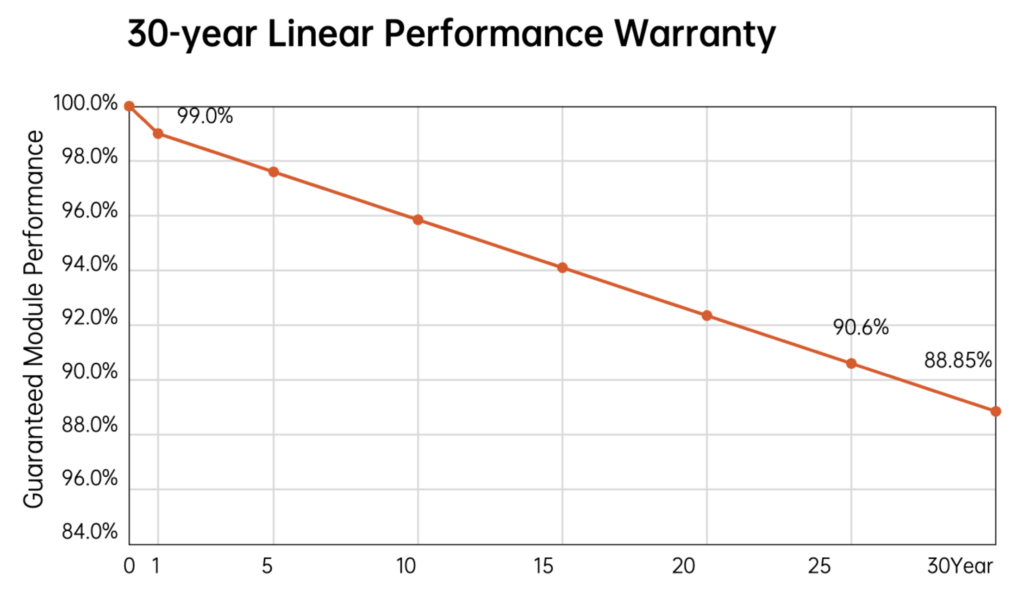
Premium only matters if it holds up over decades. Aiko positions Series 3 with a 25-year product warranty and 30-year performance warranty, plus a low stated degradation schedule (≤1% year one, then ≤0.35%/year).
If none of those outcomes applies to your home (plenty of roof space, short time horizon, no concern about heat behaviour), you may not extract the full value of paying extra. But if one of them is true, especially roof limitations, premium panels start to “change the result.”
Aiko Neostar Series 3 warranty
Aiko’s Australian Series 3 positioning is consistent across 3S and 3P: 25-year product warranty, 30-year performance warranty, and low stated degradation (≤1% year one, then ≤0.35%/year).
On the datasheet side, Aiko’s published performance curve examples also reference 90.6% at year 25 and 88.85% at year 30.
Installation still matters here. A long manufacturer warranty is only “valuable” when the installer can diagnose issues, handle paperwork, and provide aftercare support. As an example, PSW’s Aiko package positioning is explicitly built around long-term coverage and local support.
Manufacturing origin
Aiko is not a “new panel brand” in the usual sense. It was founded in 2009 as a solar cell manufacturer and later moved into modules, which is relevant because Neostar Series 3 is fundamentally a cell-technology product (back-contact/high-efficiency). AIKO operates three R&D centres (including Solarlab Europe in Freiburg, as well as centres in Zhuhai and Yiwu) and has invested heavily in R&D, with an extensive patent portfolio and ongoing advanced cell research beyond incremental upgrades.
On manufacturing, AIKO describes a scaled footprint with six major production bases, and independent industry reporting notes it has brought online additional n-type back-contact manufacturing capacity (including Jinan) tied to its high-efficiency roadmap. For a homeowner paying a premium, the takeaway is confidence in industrial-scale production, process control/traceability, and the likelihood of long-term product continuity.
General price range
Aiko Series 3 is typically priced above mainstream panels—by design. The more useful question is whether the premium meaningfully shifts your system design or long-term yield.
To ground this in a real Perth shopping context, Perth Solar Warehouse lists a 6.6 kW option with 14 × Aiko 475W Neostar 3S from $5,290+, plus inverter/battery as a base installed-array cost, after Zone3 STCs (solar subsidy). This general pricing translates to $802 kW for multiplication guidance.
This is not a substitute for a site-specific quote (roof faces, shading, switchboard, cable runs, and compliance items all matter), but it does reflect the reality: premium panels can still sit inside an “affordable system” when the full installed package is priced competitively.

Sydney Launch Event: Derek McKercher, PSW Founder, unveiling the Aiko Neostar range in Australia.
PSW's recommended choice
If you’re paying extra for Aiko Neostar Series 3, the decision should hinge on what’s limiting your system design. On an unconstrained roof, most premium panels will feel “nice to have.” On a constrained roof (space, heat exposure, awkward roof geometry, or light shade), the right Series 3 choice can materially change the outcome because it’s built around output density, hot-weather behaviour, and partial shading optimisation.
1. Aiko Neostar 3S (All-Black, Mono-Glass, 475W)—The “balanced premium” outcome. Very high efficiency, with the same Series 3 heat and warranty attributes, yet a one-colour streamlined aesthetic for better building integration. Aiko positions Neostar 3S 475W at 23.8% efficiency, with a -0.26%/°C temperature coefficient, low degradation, and a 25-year product warranty and 30-year performance warranty. This is typically the premium solar panel selection when you have a reasonable roof area, and your goal is “high performance with improved visualisation,” rather than “max power per square metre at any cost.” The Neostar 3S is, without a doubt, the highest-performing all-black solar panel in Australia in 2026.
2. Aiko Neostar 3P (Mono-Glass, 500W)—You want Aiko’s maximum output per square metre in the Series 3 residential format. Aiko positions Neostar 3P 500W, up to 25.0% efficiency, with a -0.26%/°C temperature coefficient, low stated degradation, and a 25-year product / 30-year performance warranty. This is the “roof-space weapon” when you’re trying to: (1) push more kW onto limited roof faces, (2) keep the array footprint compact while staying high-output, or (3) make each panel count on complex roofs where you simply can’t fit “one more module.” AIKO also explicitly frames the 3P 500W as a standard-format panel under 2m² (the anti-oversized argument premium buyers care about).
If you’re still torn, default to this rule: if roof space is tight (or you’re trying to keep the array compact), go 3P; if roof space is workable and you want premium performance without over-optimising, go 3S. If you’re located in the greater Perth region of Western Australia, PSW sales support is happy to assist with turnkey Aiko solar package purchasing queries.