A home battery is one of the most significant purchases a household will make. The quote is the beginning of that conversation, not the end of it.
Battery storage has moved quickly from a premium add-on to a mainstream consideration for Perth households. Rising electricity costs, improving technology, and the maturation of grid-connected systems have brought home batteries into the purchasing conversation for a far broader slice of the market than was the case even three years ago. With that growth has come a corresponding expansion of the installer field, and, inevitably, a widening of the price gap between them.
For a buyer comparing quotes, that gap can look like a straightforward opportunity. It is rarely that simple.
Contents
What a battery quote actually contains: A home battery installation involves more moving parts than most buyers anticipate. Beyond the battery unit itself, its chemistry, capacity, and warranty. Then there is the inverter configuration, the switchboard assessment, the grid-compliance documentation, the network operator approval process, and the commissioning of the monitoring platform that the household will rely on throughout the system’s operational life.
Each of those elements represents a cost. The question a comparison quote rarely answers is which of those costs have been absorbed, and which have been deferred to a future invoice, a future service call, or simply to the customer.
💡 The cheapest battery quote in Perth isn’t always the best. Sometimes it is simply a quote that has excluded things the buyer does not yet know to ask about, and will only discover once the system is installed, the installer has moved on, and something requires attention.
Western Australia’s energy transition is real, it is accelerating, and home battery storage is a meaningful part of it. Getting there with a credentialled, proven installer is not a premium; it is the baseline expectation every buyer deserves.
The support lifecycle most buyers don't consider
A home battery is a ten- to fifteen-year asset. Battery management firmware evolves. Inverter compatibility requirements shift. Grid regulations, particularly those on export controls and virtual power plant participation, are being actively revised across Western Australia as the network adapts to high solar penetration. A system installed today will need to be compliant, monitored, and serviceable throughout that entire period.
That ongoing relationship requires an installer who will still be operating in five years. In WA’s battery storage sector, that is not a certainty across the market. Businesses that entered on the back of subsidy-driven demand peaks have, in a number of documented cases, exited just as the market normalised, leaving customers with systems that function adequately on a good day, but have no commercial backstop when they don’t.
The cost of finding a replacement service provider for an orphaned battery system, one whose original installer no longer exists, is rarely trivial and falls entirely on the household. It does not appear in any comparison quote.
What longevity signals in this market
A battery installer that has operated continuously through multiple market cycles has demonstrated something substantive: the capacity to sustain a business through the ebbs and flows that characterise an emerging technology sector. It has retained trained staff. It has maintained manufacturer relationships. It has kept its accreditations current through the audits and compliance processes required by those accreditations.
These are not incidental details. They are the operational infrastructure that enables long-term support. And they cost money to maintain, which is one of the reasons businesses that carry them do not tend to offer the lowest quote in the market.
Perth Solar Warehouse operates in what might be described as the credentialled middle of the battery market, not the cheapest option, nor a premium-only commercial operator. The positioning is deliberate; deliver installations that are properly scoped, properly documented, and supported by the infrastructure throughout the system’s lifecycle. As a guide, value-driven businesses should deliver a similar broader industry alignment:
The credentials that matter specifically
Battery storage installations in Australia sit within a framework of accreditation and certification requirements that are more demanding than those for solar alone. The combination of high-voltage DC systems, grid interconnection, switchboard modification, and network operator compliance means that the credentials an installer holds are a meaningful indicator of their competence and accountability.
Accreditation
NETCC
Accredited
National baseline standard for quality and compliance: A prerequisite, not a differentiator.
Manufacturer
Tesla Premium
Certified Installer
Five consecutive years (PSW). Technical audits passed annually, not a one-time badge.
Manufacturer
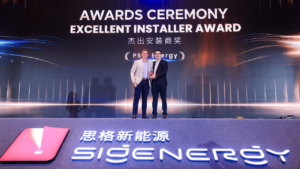
Sigenergy
Gold Installer
Top-tier status with one of the fastest-growing integrated battery platforms on the planet.
Quality Systems
ISO
Certified
ISO 9001, 45001, 14001: Independently audited quality, safety, and environmental management.
The distinction worth understanding here is between credentials that are self-declared and those that require external audit and ongoing compliance. NETCC accreditation, manufacturer certification at the top installer tier, and ISO quality management certification all fall into the latter category. They can be lost. They require sustained investment to maintain. And their presence in an installer’s profile is evidence of a business that has chosen to be held to account, because it intends to be around long enough for that accountability to matter.
Questions worth asking before accepting a quote
The battery market in Western Australia is maturing, and with that maturity comes a more discerning buying public. Households are increasingly aware that a system’s long-term performance depends as much on the installer as on the hardware. The right questions to ask before committing are not technical; they are structural.
How long has the business been operating, and specifically in battery storage? Which manufacturer certifications does it hold, and when were those last audited? What does the support model look like after installation? Who do you call, and what response can you expect? Is the business financially structured to honour warranties over a ten-year horizon? And critically: what is explicitly included in the quote, and what is not?
💡 The installer worth choosing is not the one who quotes lowest. It is the one whose business is built to support what they install, across the full operational life of a system that will sit on your switchboard for the better part of a decade and a half.
Western Australia’s energy transition is real, it is accelerating, and home battery storage is a meaningful part of it. Getting there with a credentialled, proven installer is not a premium; it is the baseline expectation every buyer deserves.
If you’re considering a home battery, we’d welcome the conversation. No pressure, just honest advice from a team that’s been doing this for over two decades